
- OUR CASES
-
Join Us
- Current Issues
-
About
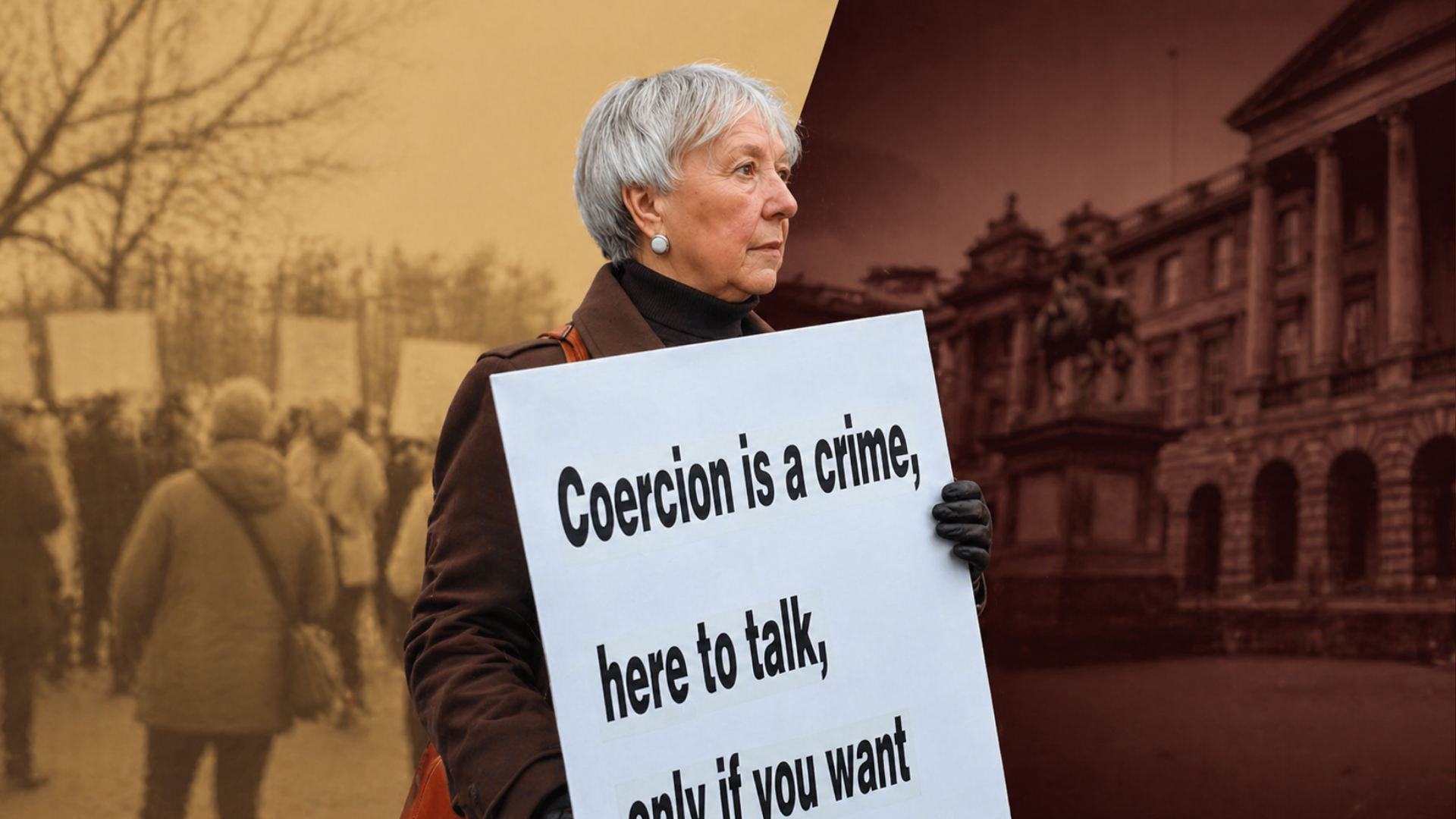
Scottish grandmother cleared in abortion clinic buffer zone free speech win
A Scottish court has dismissed criminal charges against Rose Docherty, a 74-year-old grandmother who was arrested for standing near an abortion clinic, holding a sign that read: “Coercion is a crime, here to talk, only if you want.”
Docherty was standing within a designated ‘buffer zone’. She was not harassing anyone, impeding access to the clinic, or engaging in any conduct that could reasonably be described as threatening or coercive.
She was offering conversation, on a voluntary basis, to anyone who chose to accept it. For that, she was arrested.
The court's decision to dismiss the charges is a win for freedom of speech and the peaceful expression of views.
It affirms the basic principle that the state cannot criminalise a person simply for being present and willing to speak.
Buffer zones raise serious questions under the law. Their stated purpose is to protect people accessing abortion from harassment or intimidation.
That is a legitimate goal. But the legal test that matters is proportionality: whether the restriction goes further than is necessary to achieve that purpose.
A law that captures a 74-year-old offering to talk, and subjects her to arrest for doing so, has plainly failed that test.
The relevance to Australia is direct.
We covered Docherty's case when she was first arrested, pointing out that Australian jurisdictions operate under similar laws.
When the High Court upheld Victoria's buffer zone legislation in 2019, ruling against Kathy Clubb and Graham Preston, it accepted that such restrictions could be valid.
But as the Docherty case illustrates, the validity of a buffer zone scheme in principle does not resolve the question of how far its application may lawfully extend.
Australian courts have already grappled with this tension, and the risk of overreach remains real.
The lesson from Scotland is that courts can and should hold the line. Laws designed to prevent intimidation must not become instruments to silence lawful, peaceful expression.
The right to speak, and to offer to speak, is not forfeit simply because the state has drawn a zone on a map.
HRLA continues to monitor the application of buffer zone laws in Australia, and to advocate for legal frameworks that respect the law while allowing for the fundamental right to express a view.
Let’s be thankful that, in this instance, common sense prevailed.
Do you like this page?